
Spire — Mac download
Download (158 MB) Earlier builds
Ticked
A producer drops a bassline into the timeline, opens the synth, and starts scrolling through Spire's wavetable options until the low end has exactly the right weight.
Spire — A virtual polyphonic synthesizer built by Reveal Sound.
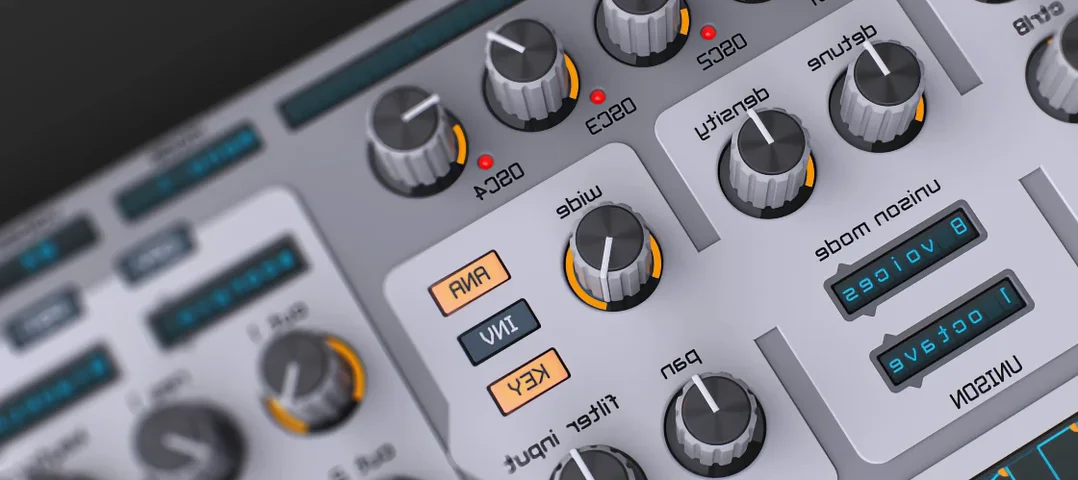
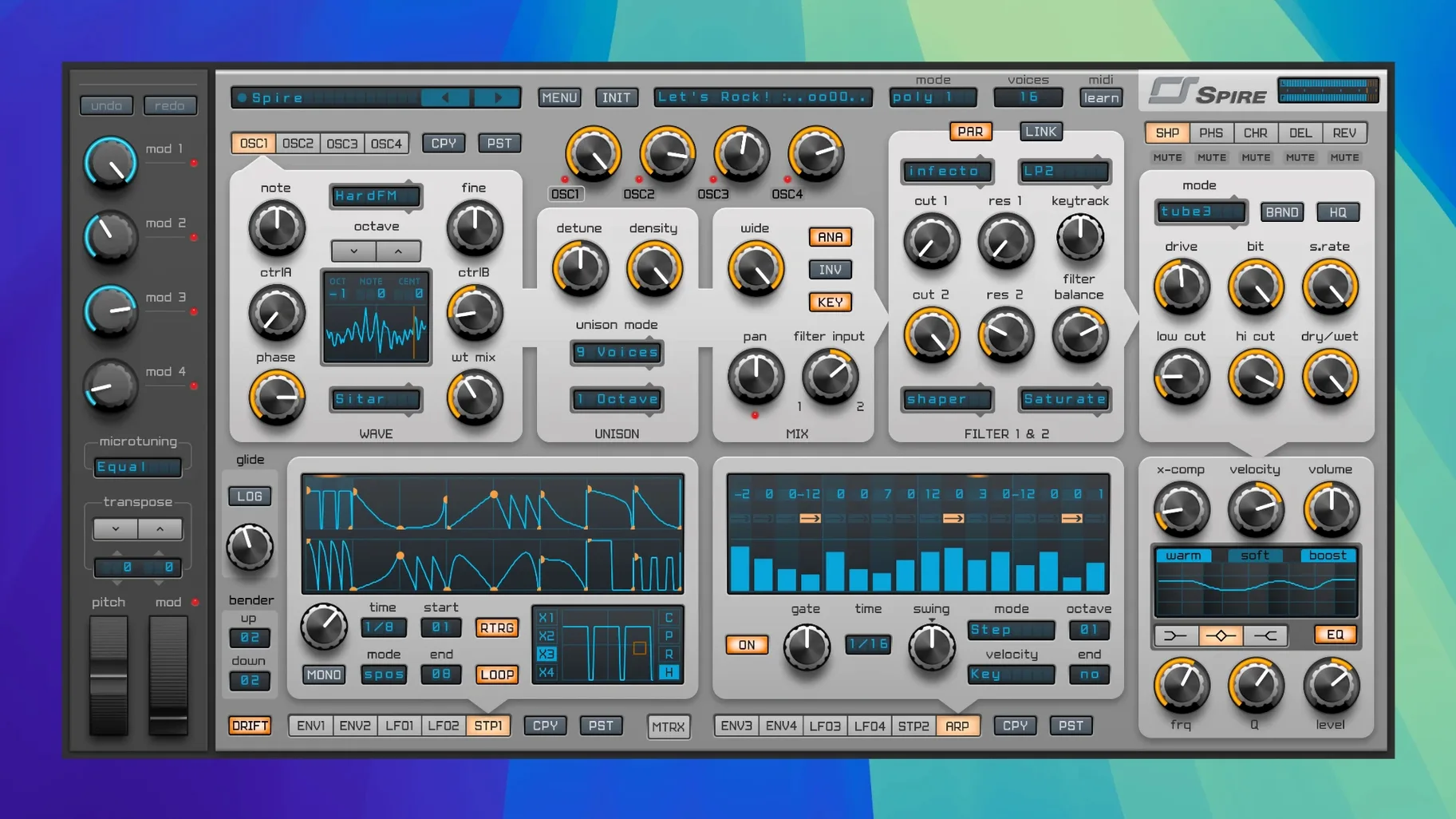
Oscillator section — Four sound sources with classic and wavetable waveforms, plus FM and sync modes.
Modulation — Two LFOs and two ADSR envelopes for shaping movement and dynamics.
Effects rack — Built-in delay, reverb, distortion, phaser, and EQ for finishing sounds without leaving the plugin.
Crafting raw patches with deep modulation
- Producers building patches from raw waveforms
- Sound designers who want deep modulation routing
- Electronic music where the synth is the lead character
Not for lightweight preset skimming
- Quick preset-browsing with minimal tweaking
- Lightweight setups — it can hit the CPU
Will it run natively on Apple Silicon?
Does spire for mac run natively on Apple Silicon? Yes. Version 1.5.19 includes ARM support alongside x86 64-bit. If you are on an M1, M2 or M3 machine, the plugin loads without Rosetta in any DAW that hosts native AU or VST3.
Will I find enough presets to start making music immediately? The factory library ships over 1500 patches — basses, leads, pads, plucks, arps and sequences. You can load a preset, tweak the macro knobs and have a usable sound in seconds. For sound designers who prefer starting from init, the oscillator section is fully exposed and labelled clearly.
Is spire mac torrent activation complicated? The included instructions cover installation and activation for build 5343. Follow the numbered steps in the order they appear. Once activated, Spire works offline and does not phone home.
Does it work in Logic Pro and Ableton Live? AU and VST3 formats are provided. Logic and Ableton are the two most common hosts in the user base, and the plugin is tested against both. FL Studio on Mac and Bitwig users also report stable performance.
How heavy is the CPU hit? Spire runs four oscillators per voice, a multimode filter, two LFOs and a full effects rack. On a modern Apple Silicon machine, a typical patch with three-note chords sits around 15–25% on one core. Older Intel Macs feel it more — expect to freeze or bounce tracks on dense arrangements. The plugin is not lightweight, but it is not careless with resources either; voice management is predictable and the UI stays responsive even when the session gets busy.
Building a pluck from scratch — a short walkthrough
- Open Spire on a new instrument track. Right-click the patch name and choose Init preset to clear everything.
- In the oscillator section, set Osc 1 to wavetable and pick a saw-like shape. Enable Osc 2, set it to a sine and tune it up seven semitones for a layered attack.
- Switch the filter to LP 24 dB, pull the cutoff down to around 800 Hz, and push the envelope amount to about 60%. This gives the pluck its body.
- Head to the amp envelope. Set attack to zero, decay to 300 ms, sustain to zero and a short release of 40 ms. The sound should now snap and fall away quickly.
- Assign LFO 1 to oscillator pitch. Use a fast, downward saw shape with a tiny amount — just enough to add a click at the front of the note.
- In the effects rack, add a touch of reverb (wet around 15%, decay under 1.2 seconds) and a ping-pong delay synced to dotted eighths with feedback at 25%.
- Save the patch. Drop it into a chord progression and adjust the filter cutoff per section to open or close the sound across the arrangement.
Instant folder-based patch browsing
Spire loads patches faster than most wavetable synths of its depth. The preset browser is flat and folder-based — no database indexing, no thumbnail generation. You click a folder, you see names, you pick one. Browsing 1500 patches while the transport runs rarely causes a dropout on Apple Silicon.
Stability is a strong point across builds in the 1.5.x line. Crash logs from Logic and Ableton users seldom point to Spire as the culprit; the plugin handles automation lanes and parameter changes without glitching. Undo and redo inside the synth works reliably, which matters when you are deep in sound design and want to backtrack two or three moves.
Resource use is the trade-off. A single instance with unison on three oscillators and the reverb tail active can push an Intel i7 into audible buffer underruns below 256 samples. The workaround is simple — bounce the part, disable the effects rack while tracking other elements, or increase the buffer. On Apple Silicon, the same patch runs comfortably at 128 samples with plenty of headroom left for other plugins. The effects rack is a particular CPU factor; the reverb algorithm is lush but not cheap. If you track with effects on, keep an eye on the performance meter.
Cutting a supersaw through a dense mix
An artist preparing a vocal trance track opens a session with 40 channels already in play. She needs a supersaw lead that cuts through a dense midrange without masking the vocal.
She loads Spire, skips the factory presets and pulls up a patch she built the week before — two detuned saw waves through a bandpass filter, with a slow LFO on the filter cutoff for motion. The patch sounds right, but it fights the vocal at 2 kHz. She opens the EQ module in the effects rack, drops a bell curve at 2.2 kHz by 3 dB, and widens the Q just enough to carve a pocket.
She adds a second instance for a pluck arpeggio, uses the step sequencer to program a rhythmic pattern, and syncs it to the project tempo. The arp runs through the built-in phaser at 40% mix, giving it a swirling stereo spread without cluttering the centre image. Both instances stay stable at 128 samples on her M1 Max. She bounces the arp to audio later in the session to free up resources for the mastering chain.
By the end of the afternoon, the lead and the arp are printed and sitting cleanly in the arrangement. Spire handled both roles without crashing, without popping, and without forcing her to compromise on the sound she had in her head.
- Version 1.5.19 ships as build 5343
- macOS 10.13 or later
- Intel or Apple Silicon Mac
Questions the team asks
Spire is a polyphonic virtual synthesizer plugin from Reveal Sound with four oscillators, wavetable support, and a built-in effects section.
Yes. Spire requires macOS 10.13 or later and supports both Intel and Apple Silicon Macs.
The plugin includes delay, reverb, distortion, phaser, and EQ.





Comments 0
Sign in or create an account to add a comment.
No comments yet. They go up after moderation.