

Xpand!2 — Mac download
Ticked
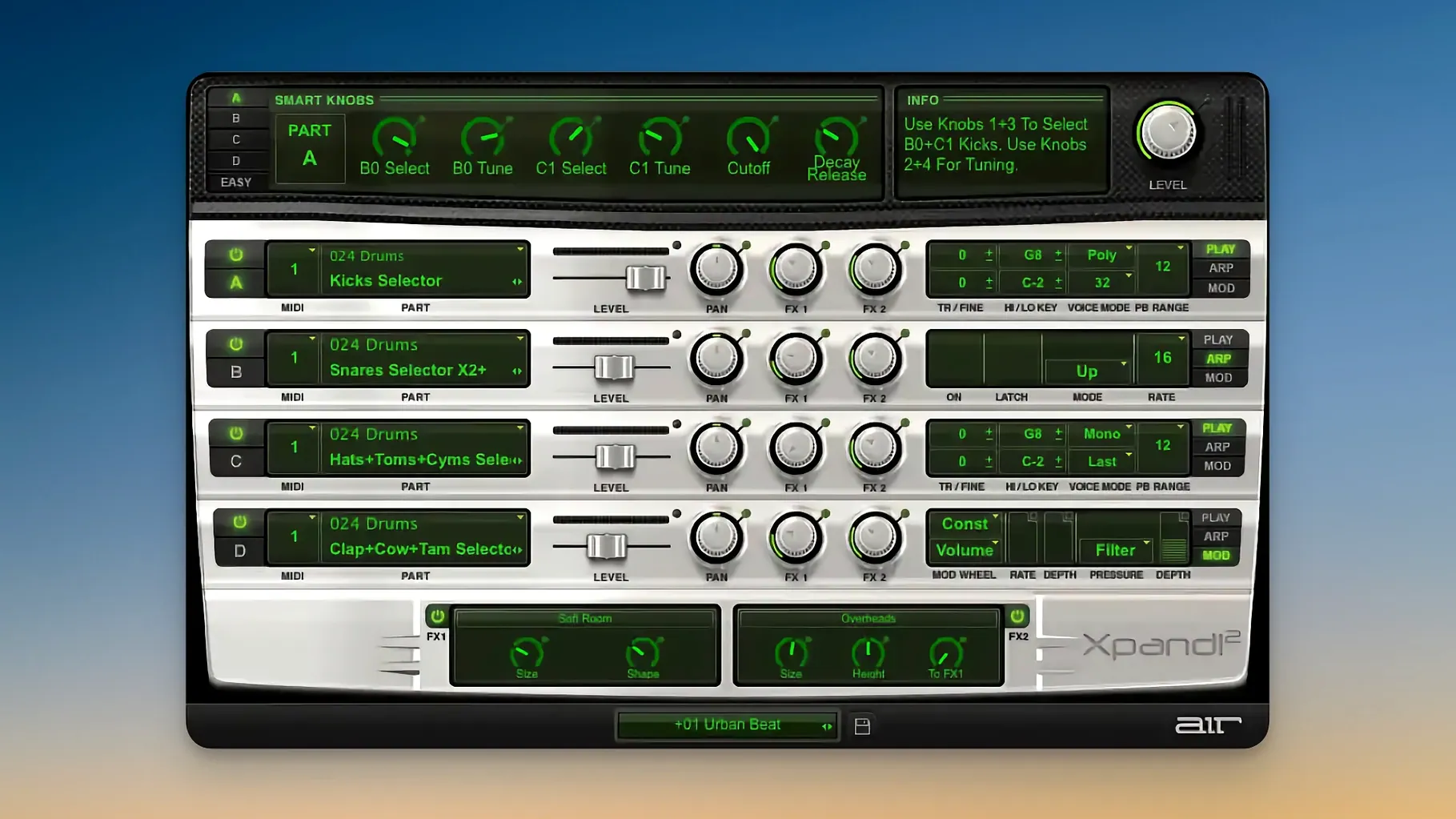
… per slot, with its own note range, arpeggiator and effects chain. That four-part multitimbral engine is what gives Xpand!2 its flexibility — four sounds stacked, split or layered in a single patch.
Apple Silicon native with AU, VST and AAX support
- Runs natively on Apple Silicon — no Rosetta required.
- Requires macOS 13 or later.
- Available as VST, AU and AAX — covers Logic Pro, Ableton Live, Cubase and Pro Tools.
- HiDPI and Retina displays supported; the interface scales to fit your screen.
- Single language: English.
Sound and editing
2,500 presets across 29 categories, from pads and strings to arpeggiated synths. Each of the four slots gets its own arpeggiator, modulation, mix level and note range, with six smart controls for quick tweaks. Fifty built-in effects — reverb, delay, chorus and Chaos Delay among them — sit ready per slot, so a single patch can carry four independent sound engines with their own processing.
Four parts in a songwriter's afternoon
A songwriter opens a blank session in Logic Pro. One instance of Xpand!2 — not four separate plugins. Slot A gets a soft felt piano from the Keys category, MIDI channel 1, polyphonic, note range C2–C5. Slot B adds a warm string pad on channel 1 too, same range, mixed lower. Slot C loads a percussive arpeggiated sequence on channel 2, monophonic with last-note priority, triggered from C1–B2. Slot D sits on channel 3 with a sub-bass patch, mono, highest-note priority. In under five minutes the verse and chorus share one plugin window, each part clearly visible in the four-slot layout. The arpeggiator on slot C locks to host tempo; a touch of Chaos Delay on slot A widens the piano without muddying the mix.
Four-part layering beats deeper libraries for speed
Xpand!2 leans heavier on multitimbral workflow than most romplers. Three comparisons worth knowing:
- SampleTank 4 — deeper library, more sample content, but the four-part layering in Xpand!2 feels quicker to set up. SampleTank rewards sound browsing; Xpand!2 rewards fast stacking.
- Korg M1 VST — iconic late-80s character, but locked to one sound per instance. No arpeggiator per part. Xpand!2 covers similar territory (pianos, strings, pads) while letting you blend four M1-ish patches in one window.
- UVI Workstation — excellent for orchestral and acoustic realism, but subtractive and FM synthesis take a back seat. Xpand!2 mixes synthesis types per slot, so a wavetable sweep, an FM bell and a sampled choir coexist in the same patch.
None of those three let you assign separate note ranges and MIDI channels per sound as directly. For keyboard splits and layered performances, the four-slot grid in Xpand!2 cuts out a lot of routing work.
Right-click any control for instant MIDI Learn
- Right-click any control for MIDI Learn. No menu diving. Assign a hardware knob to slot volume, filter cutoff or arpeggiator rate in one click.
- Drag slot tabs to reorder parts. Slot order matters for voice-stealing priority. Dragging a pad to slot A gives it first call on CPU voices before the arp in slot D.
- Alt-click a smart control knob to reset it to the preset default. Useful when you have twisted six knobs and lost the original balance.
- The Chaos Delay effect is easy to overlook among 50 effects. It adds modulated, stereo-widened repeats that turn a static arpeggio into something unpredictable — try it on slot C or D with a short decay.
- Monophonic note priorities are per slot, not global. Set a bass part to Lowest and a lead to Highest; both respond differently to the same chord input from one keyboard zone.
- HiDPI scaling hides in the settings cog. On a 5K display the default size can feel cramped — two clicks and the whole four-slot grid fills the screen properly.
- macOS 13 or later
- Apple Silicon
Questions the team asks
Yes, version 2.3.1 supports Apple Silicon natively and requires macOS 13 or later.
Each patch holds four parts — each with its own note range, arpeggiator, mix, modulation and effects.






Comments 0
Sign in or create an account to add a comment.
No comments yet. They go up after moderation.