

Cycling '74 Max — Mac download
Download (924 MB) Earlier builds
Ticked
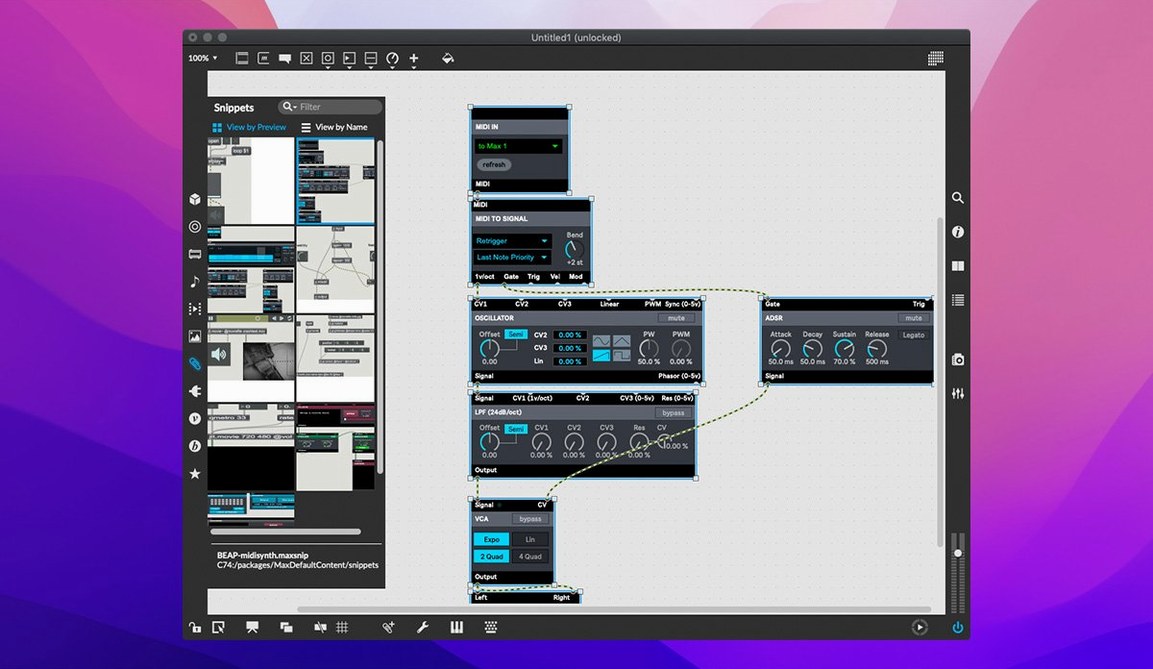
Max is an interactive visual programming environment. You connect modular objects on a canvas to build unique sound tools, synthesisers, performance systems, and audiovisual installations—without writing traditional code.
It suits sound designers, electronic musicians, media artists, and researchers who need precise control over signal processing and event logic. The workspace is built around hundreds of ready-made objects and UI widgets. Every object includes a working interactive help patch, so you learn directly by tinkering.
Max handles many simultaneous tasks. It runs multiple applications and audio processes at once, limited only by your computer's memory and speed. The bundled RNBO environment lets you export patches to hardware, plugins, and web targets.
Version 9.0.9 ships with RNBO v1.3.5 and a few targeted fixes. An Inspector crash when editing text fields is resolved, and live.banks now supports button assignments for parameter banks. The web-based text editor also handles external and subpatcher file listings correctly again.
First session: a sound designer’s walk-on patch
A theatre sound designer opens Max on a Friday afternoon. The brief asks for a real-time cue system that crossfades three stereo ambiences under MIDI footswitch control. She drops a sfplay~ object, three gain~ sliders, and a matrix~ for routing. Twenty minutes later the patch talks to QLab via a virtual MIDI bus. She saves it as a standalone application using RNBO and hands the cast a single icon to double-click. No Max licence needed on the playback machine.
Set the I/O vector size before you play live
- Audio Status window. Open it from the Options menu. Set I/O Vector Size to 128 samples if you play live—lower latency matters more than CPU headroom here. For offline renders, push it to 1024.
- Overdrive and scheduler. Check Options > Audio Settings. Enable Overdrive for DSP-heavy patches; it tells the scheduler to prioritise audio threads. Disable it while debugging MIDI timing if notes drift.
- Autocomplete behaviour. In the Inspector for any object box, toggle Auto-complete Text. When you type
cycle~wrong at 11pm, the correction saves you hunting through the reference. - File preferences. Set a default search path under File Preferences. Point it at your sample library and Max finds
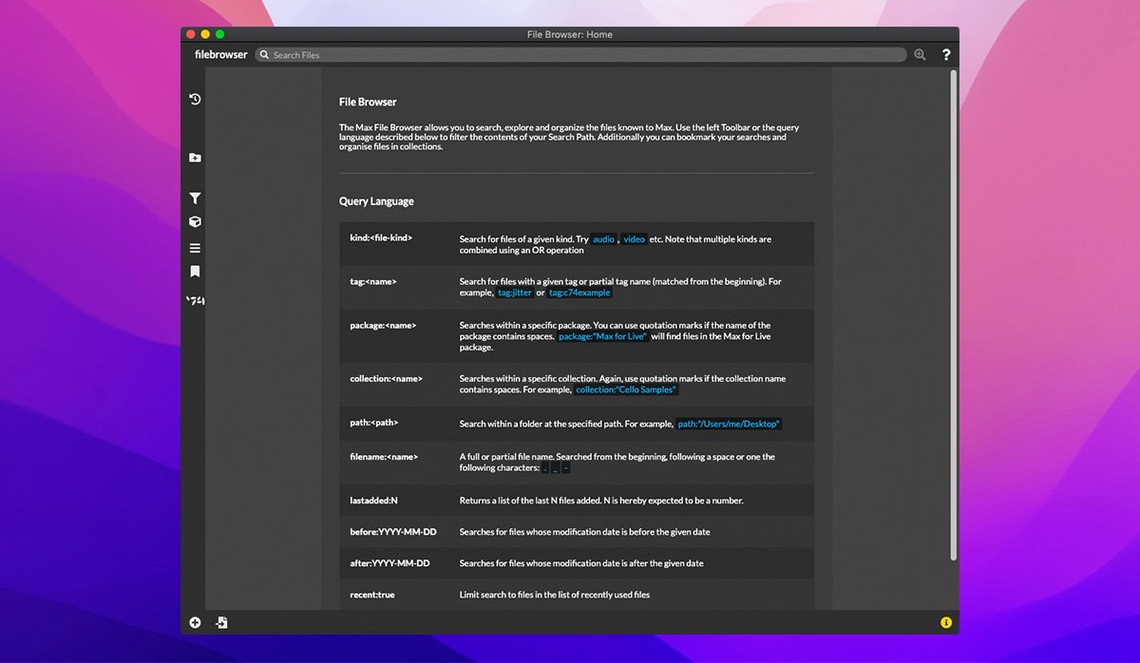
sfplay~files without absolute paths—essential when you move a project between machines. - Presentation mode grid. Enable a snap grid under View > Grid. Pixel-aligned UI layouts on a rushed tech rehearsal stop you looking sloppy.
Cold launch in under four seconds
Max 9.0.9 starts cold in under four seconds on an Apple Silicon Mac. The patcher window redraws large canvases without flicker, even when you drag a cable across 200 objects. Audio dropouts are rare at sensible vector sizes; the engine only stutters when a patch introduces a feedback loop you forgot to guard.
RAM use stays modest—a blank patcher idles around 180 MB. Loading a dozen sample players with IRCAM-quality convolution pushes that toward 2 GB, which is still light for what it does. CPU spikes show honestly in the performance meter, and the overdrive scheduler keeps the UI responsive when the signal graph runs hot.
RNBO export is the surprise. A simple physical-model patch compiles to a VST in under a minute. The exported plugin loads in a DAW with the same timing and voice count as the Max canvas—no translation quirks, just a clean hand-off. For anyone searching msp download or max 9 crack to try before committing, this version runs solidly enough to judge the tool on its own terms.
- live.banks gains support for button assignments on parameter banks.
- RNBO v1.3.5 is bundled.
- Inspector crash when editing or closing a text field is fixed.
- macOS 11 or later
- 64-bit Intel or Apple Silicon Mac
Questions the team asks
Yes. Each object provides an interactive help demonstration that shows exactly how it works, so you can learn while building.








Comments 0
Sign in or create an account to add a comment.
No comments yet. They go up after moderation.